Premium Visual Front Matter & Table of Contents
This premium study guide is meticulously designed in strict alignment with the National Education Policy (NEP) 2020 and the National Curriculum Framework for School Education (NCF-SE) 2023. Shifting away from rote memorization, this guide focuses on “experiential learning” and “socio-emotional development.” By analyzing the profound bond between Gajaraj and Buntee, the spiritual depth of Jill Wolf’s “A Friend’s Prayer,” and the practical discernment modeled in “The Chair,” students move beyond simple literacy to develop the empathy and critical reasoning necessary for navigating complex social landscapes.
Table of Contents
  1. Strategic Learning Framework
    • NCERT Objectives & Real-World Competencies
    • Check Your Previous Knowledge (Experiential Inquiry)
  2. Visual Architecture
    • The  Friendship Indexing Model
    • Concept Map: The Social Web of the Royal Stable
    • One-Page Mind Map Summary
  3. Narrative Deep-Dive: Explanation & Analysis
    • Complete Chapter Explanation (Evaluative Perspective)
    • Line-by-Line Analysis: Pivotal Textual Evidence
    • Narrative Revision Summaries
  4. Character Profiles: Emotional Archetypes
    • Character Sketches: Gajaraj, Buntee, Mahout, Farmer
    • Guardian Comparison: Transition from Duty to Empathy
  5. Linguistic Mastery: Vocabulary & Philology
    • Premium Sensory Vocabulary Chart
    • Evolutionary Analysis: From Abhinha Jataka to Poorvi
  6. Integrated Grammar & Phrasal Logic
    • Tense Matrix: Chronological Logic in Action
    • Morphology: Prefixes for Antonymic Transformation
    • Coordinating Logic: Neither/Nor vs. Either/Or
  7. The “Friendship Suite”: Supplementary Texts
    • The Invisible Chair Experiment Analysis
    • Stanza Analysis: A Friend’s Prayer
  8. Real-World Case Study: Tarra and Bella
    • Timeline of a Companionate Bond (1974–2021)
    • Evaluating Somatic Grief and Herd Support
  9. The Ultimate CBSE Question Bank
    • MCQ Marathon (50 Items) & Objective Drills
    • Short, Long, and HOTS Analytical Prompts
  10. Final Revision & Exam Preparation
    • Story Skeleton & Self-Assessment Checklist
[!TIP] How to Use This Guide Cognitive science shows that active recall is enhanced by Visual Anchoring. Use the Concept Maps to visualize emotional distance before diving into the text. Pay close attention to the Line-by-Line Analysis; in competitive assessments, the ability to cite specific textual evidence (e.g., “Gajaraj winced”) distinguishes a Master student from a surface-level reader.
Having established the structural foundation of our study, we now transition to the Strategic Learning Framework to define our curricular goals.
 
Objectives & Previous Knowledge
In alignment with NCF-SE 2023, setting clear “Curricular Goals” (CG-1 to CG-5) is the first step toward transforming a classroom lesson into a life competency. This framework ensures that students are not just reading a story but are building the cognitive tools for independent reasoning.
 
NCERT Learning Objective (CG)
Real-World Competency
CG-1: Independent reading & summarizing.
Synthesis of complex information into actionable insights.
CG-2: Writing about thoughts and feelings.
Development of Emotional Intelligence (EQ).
CG-3: Effective questioning and describing.
Logical communication in social and professional settings.
CG-4: Exploring literary devices (Imagery).
Aesthetic appreciation and nuanced interpretation.
CG-5: Linguistic recognition (Tense/Structure).
Professional clarity and syntactic precision.

Narrative Deep-Dive: Explanation & Analysis
Narrative reconstruction allows students to evaluate the text as a series of emotional choices rather than just a plot.
Complete Chapter Explanation
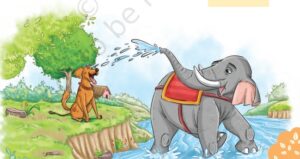
Gajaraj, a royal elephant, lived in the king’s stables surrounded by material luxury. Despite his “royal comforts,” he suffered from emotional isolation. This highlights the key differentiator between caretaking (duty) and friendship (emotional resonance). When a hungry stray dog (Buntee) entered the stable, Gajaraj’s altruistic sharing of food initiated a non-transactional bond.
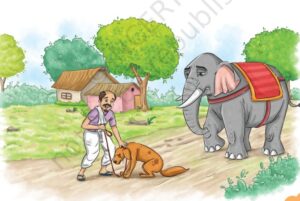
The conflict arises when a farmer reclaims Buntee. Both animals exhibit Somatic Grief—a physical manifestation of emotional trauma—by refusing to eat. The mahout’s initial diagnosis of “indigestion” represents the human tendency to look for physical causes for emotional problems. The resolution occurs not through force, but through the farmer’s empathy-driven decision to free Buntee, proving that true care prioritizes the beloved’s needs over the owner’s rights.


Exercise Files
Class 6 English (Poorvi) Unit 2 – Friendship (pdf)
958.84 KB